
Off-Axis Parabolic Mirror Selection Guide
Parabolic mirrors have the ability to focus collimated light without introducing spherical aberration. An Off-Axis Parabolic (OAP) mirror is simply a side section of a parent parabolic mirror. Collimated light that is incident to an OAP mirror is focused to a point. However, unlike a centered parabolic mirror, an OAP mirror has an advantage in that it allows more interactive space around the focal point without disrupting the beam as shown in Figure 1.
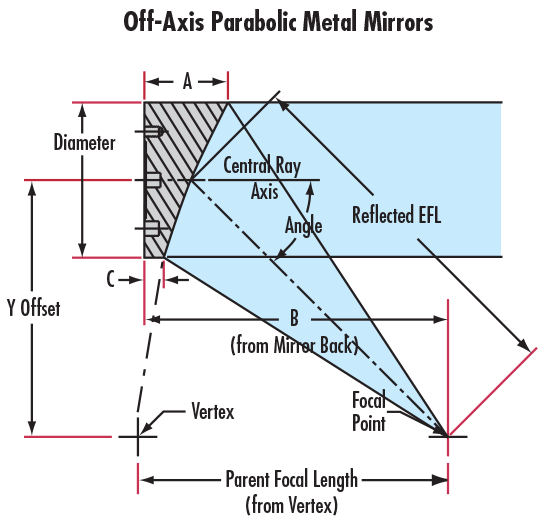
Figure 1: Off-Axis Parabolic Metal Mirrors
Depending on which section of a parabolic shape an OAP mirror is replicating, the angle between the focal point and the central ray axis can be large or small. Figure 2 represents this phenomena by modeling a 15° and 45° off axis mirror respectively. Note: It is important to keep the incident beam parallel to the optical axis, any angular displacement will produce comatic aberration.
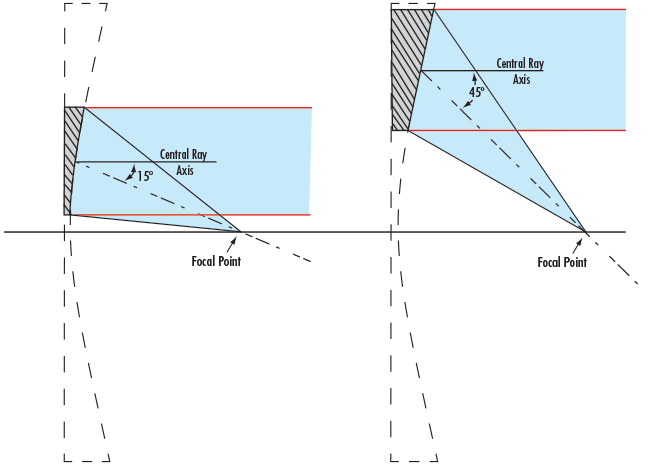
Figure 2: Diagrams of 15° and 45° OAP mirrors
Edmund Optics offers three types of off-axis parabolic mirrors: metal, high performance, and low scatter. Table 1 compares the substrate, controlled scattering ability, and price of the three different types.
Selection Guide
The following selection guide provides helpful information detailing the strengths and limitations of each OAP type.
Off-Axis Parabolic Metal Mirrors
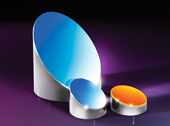
Metal mirrors are available in 15°, 30°, 45°, 60°, or 90° Off-Axis options. Each of these options comes with a coating choice of Protected Aluminum, Protected Gold, or Bare Gold. These coatings allow great reflectivity across a range of spectral regions. Edmund Optics also offers different diameter selections for each coating and angle. Typically, these mirrors are used as collimators in Schlieren and MTF systems, but gold coated off-axis parabolic mirrors can also be used in FLIR test systems.

Figure 3: Theoretical Reflectance Curves for Metal Mirror
Strengths | Limitations |
ØAluminum substrate mirrors. ØAvailable in 15°, 30°, 45°, 60°, or 90° Off-Axis Options ØAluminum and Gold Coating Options | ØDue to the 175Å surface roughness, these mirrors are not suitable for visible and UV applications that require low scatter |
High Performance Off-Axis Parabolic Mirrors
Edmund Optics also offers high performance glass substrate off-axis parabolic mirrors with superior surface accuracy for increased focusing ability. Typical applications include use in Czerny-Turner and Littrow spectrometer configurations and in general collimator and beam expander setups. These mirrors work extremely well in the UV to visible light spectrum.
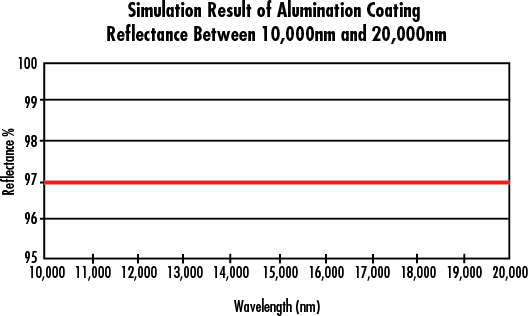
Figure 4: Simulation Result of Aluminum Coating Reflectance between 10,000nm and 20,000nm
Strengths | Limitations |
ØHigh Quality Glass Substrate Øλ/4 or λ/2 Surface Accuracy ØIdeal for UV and Visible Applications ØTypically longer focal length | ØRequires angled mounting making alignment more challenging ØGlass substrate is not suitable for terahertz frequency applications |
Low Scatter Off-Axis Parabolic Mirrors
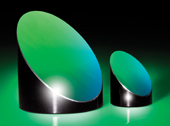
TECHSPEC® Low Scatter Off-Axis Parabolic Mirrors are designed to direct and focus incident collimated light at a specific angle with minimal scatter loss. By using a specialized manufacturing process, the aluminum substrate low scatter OAP mirrors decrease scatter in the visible spectrum. Each mirror has been visually inspected with a HeNe laser to ensure low scatter.

Figure 5: Typical Scatter Profiles. Left is standard grade OAPM, while right is TECHSPEC® Low Scatter OAPM
Strengths | Limitations |
ØDesigned for Low Scatter in the Visible Spectrum ØAluminum Substrate Mirrors ØImproved Surface Roughness and Surface Figure | ØMust operate in a clean environment |
版權(quán)所有 © 2026 江陰韻翔光電技術(shù)有限公司 備案號:蘇ICP備16003332號-1 技術(shù)支持:化工儀器網(wǎng) 管理登陸 GoogleSitemap


